

Solidus
“Time destroys the speculation of men, but it confirms nature.” - Marcus Tullius Cicero

Looking at the “depreciation” of Token values since our publication of our post “The Sicilian Expedition” at the end of May which was effectively the top, when it came to selecting our title analogy we decided to go for “Solidus”:
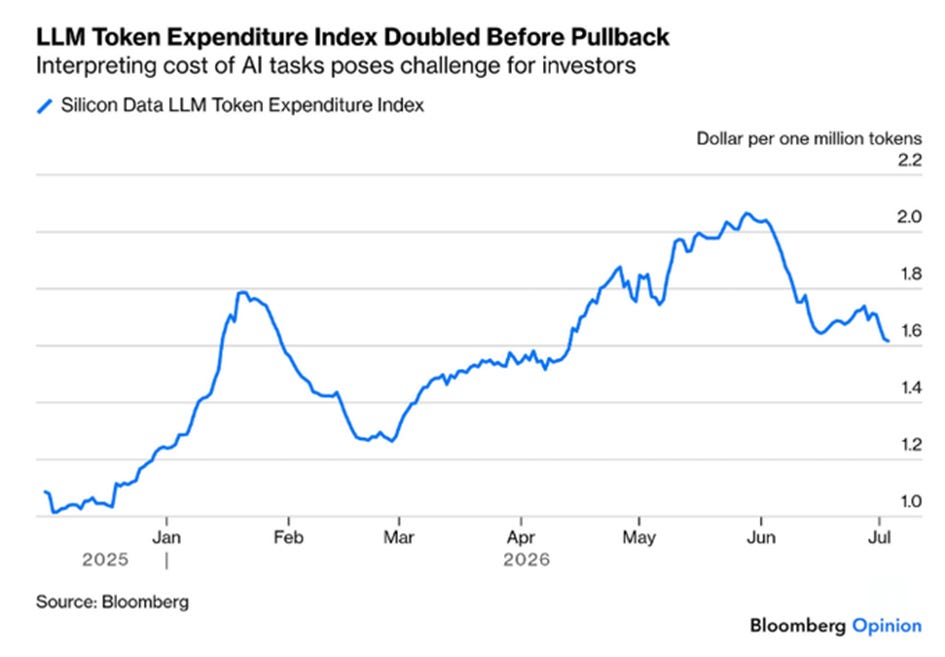
“The Silicon Data LLM Token Expenditure Index, which blends token price and usage, is ... down almost 20% from a high in May after nearly doubling since its inception in December.” - Graph source Bloomberg – X/Twitter
At the end of May we mused around the fact that the US dollar seems to be following the Silver Denarus trajectory in conjunction to the political system during the Roman period following the Crossing of the Rubicon. We also argued at the time that “tokens” value in the AI space would need to depreciate significantly, as such no wonder the OpenAI IPO was therefore delayed.
This is what we wrote back at the end of the month of May:
“It is not only the falling value of the US Dollar as measured by the rising price of Gold that needs to be taken into account but current dizzying valuations in the AI space, do make us feel that “token” value will have to drastically come back down and valuations in the space as well. One thing for sure, the fight is intensifying and will go more “vertical” given we have read recently that French Mistral AI wants to build its own chips to “outpace” Wall Street. Sovereignty matters more and more, as such you can expect various regions and countries to follow not only energy/food independence and rare earths sourcing but, as well “independent AI”. This we think is why “scarcity” matters and supply management has been the dominating feature of the success of the Chinese economy in recent years.” – Macronomics, May 2026
But why “Solidus” as a title analogy you might already be wondering? The “Solidus” was the gold coin introduced by Constantine the Great in 309 AD. It was the backbone of the Roman Empire’s monetary system for over 1,000 years, symbolizing stability, trust, and enduring value—until its gradual debasement contributed to the fall of Rome. This aligns beautifully with our past warnings about US fiscal overreach, gold as “civilized money,” and the risks of currency manipulation in the year where the United States is celebrating its 250th anniversary.
The Solidus was 95% pure gold and stable for centuries, making it the most trusted currency of its time. Its debasement under later emperors (reducing gold content to fund wars/debt) mirrors modern fiscal dominance (US debt monetization, QE, gold as a hedge). The word “soldier” is ultimately derived from “Solidus”, referring to the solidi with which soldiers were paid. In the French language, which evolved directly from common or vulgar Latin over the centuries, “Solidus” changed to “soldus”, then “solt”, then “sol” and finally “sou”. Although the sou as a coin disappeared more than two centuries ago already, the word is still used as a synonym of money in many French phrases such as: “avoir des sous”, meaning being rich.
In Western Europe, the “Solidus” was the main gold coin of commerce from late Roman times to the Early Middle Ages. In Late Antiquity and the Middle Ages, the “Solidus” also functioned as a unit of weight equal to 1⁄72 Roman pound (approximately 4.45 grams).
We already discussed “Digital Gold” aka Bitcoin in our February conversation entitled “Civilized Money”. We consider Bitcoin to be more a big “GAFA” (Google, Apple, Facebook and Amazon play), due to its “beta” characteristics.
Though one could argue that last 3 months have seen both “Gold” and its digital counterpart “Bitcoin” move in sympathy:
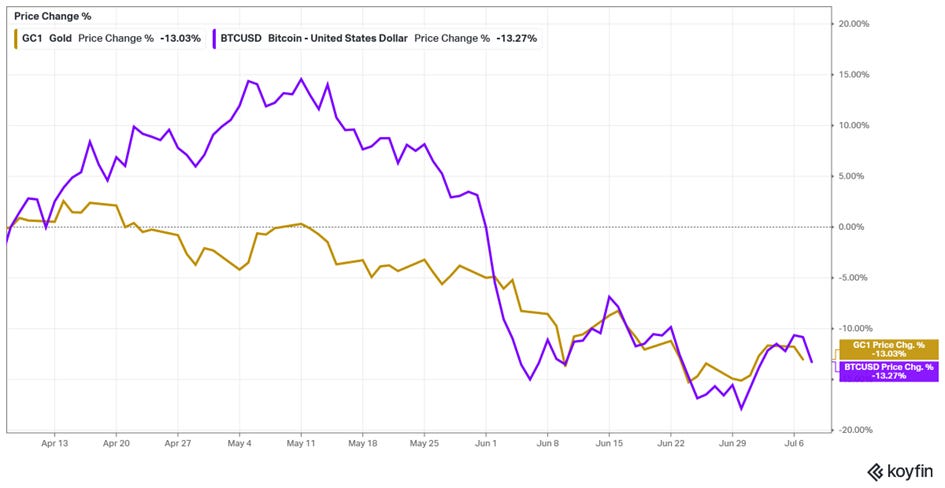
- Graph source Macronomics – KOYFIN
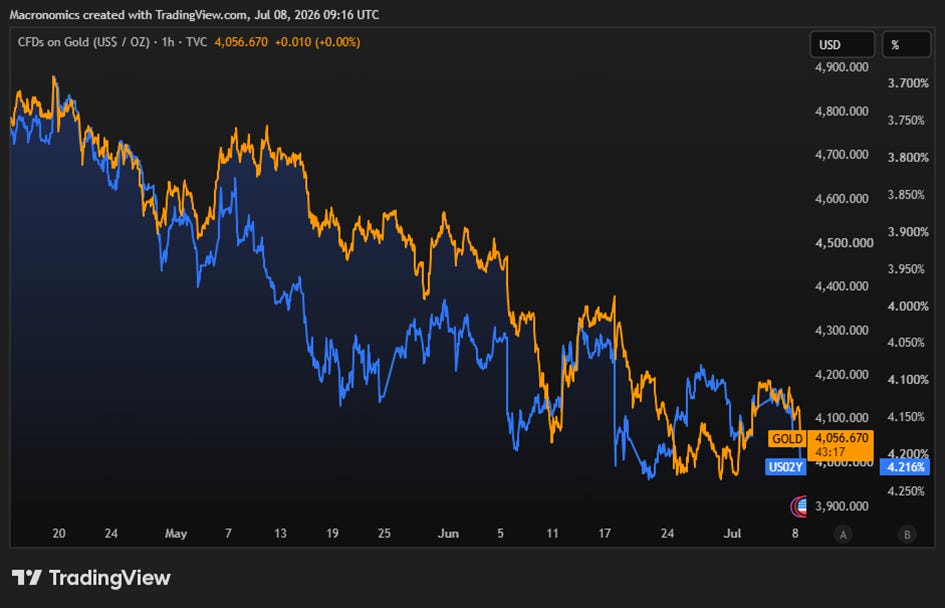
The culprit obviously on the significant weakness seen in the “barbarous relic” and its counterpart has been rising real yields in general and the United States 2 years Treasury note yield in particular as per the below chart (with inverted 2 years):
- Graph source Macronomics – TradingView
The inverse co-movement between gold and 2-year U.S. Treasury yields remains tight and persistent in the short-to-medium term, with gold continuing its decline amid elevated/rising yields. Real-yield sensitivity also stays relevant, though moderated by structural factors.
Latest Chart Observations (May–Early July 2026):
Gold (orange line): Traded from highs near $4,850–$4,900 in early May down to ~$4,056.67 on the chart (slight fluctuations around $4,050–$4,140 recently).
Inverted 2Y yield (blue line): Tracks closely with gold. Actual 2Y yields have risen overall from ~3.75–3.85% to ~4.19–4.21% recently, putting downward pressure on gold.
Both lines show correlated declines with some short-term wiggles, confirming the opportunity-cost channel (higher yields → less attractive non-yielding gold). The relationship holds strongly in this window.
Over the charted ~2.5-month period:
Gold Δ ≈ -$800 to -$850/oz.
2Y yield Δ ≈ +0.35 to +0.45% (+35 to +45 bp).
Approximate beta:
~-1,900 to -2,300 USD/oz per 1% (100 bp) rise in 2Y yield.
Per 1 bp rise in 2Y yield → Gold down ~$19–$23/oz (roughly -0.47% to -0.57% at ~$4,057 levels).
This short-term sensitivity is steeper than longer-term averages, reflecting the concentrated yield pressure and limited offsetting safe-haven flows in this window. The fit remains high visually (tight tracking).
Implications for “upside per bp”:
· +1 bp in yields → Gold downside ~$19–$23/oz.
· -1 bp in yields → Gold upside ~$19–$23/oz.
We think it is another manifestation of Gibson paradox:
The Gibson Paradox refers to the historical observation that long-term interest rates tend to move in the same direction as the general price level (inflation), rather than inversely as economic theory might suggest.
Gold’s price action in 2026 illustrates that real yields set the tactical pace, while other factors provide resilience on the downside with central banks buying.
2026 YTD (Q1): Robust start with net purchases of 244 tonnes (up 17% quarter-on-quarter and above the five-year average), despite some gross sales. Activity continued positively into April (net +17 tonnes, led by Poland and China).
This represents the 17th consecutive year of net central bank buying since the Global Financial Crisis in many analyses. Buying remains geographically widespread but concentrated among emerging markets:
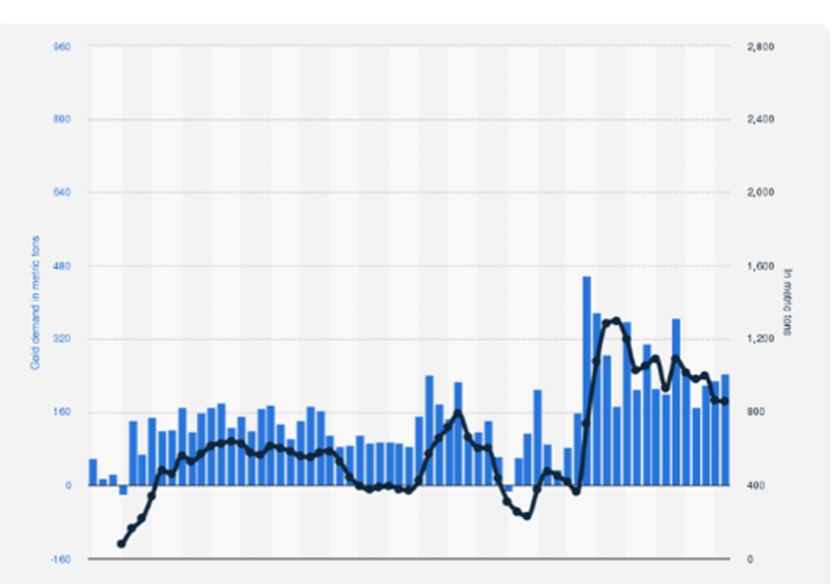
Quarterly central bank gold demand (tonnes) showing the post-2022 surge (blue bars and line). - Graph source Statista.com
Motivations (from WGC Central Bank Gold Reserves Survey 2026)
The latest WGC survey (76 responses, record engagement) reveals highly bullish sentiment:
· 89% expect global central bank gold reserves to increase over the next 12 months.
· A record 45% expect their own reserves to increase (up significantly from prior surveys).
· Only ~1% expect a decrease in their own holdings.
· Key reasons for holding/adding gold: Strong performance during crises, portfolio diversification benefits, inflation hedging, geopolitical risk protection, and overall value preservation.
· 74% anticipate moderate or significantly lower US dollar shares in global reserves over the next five years, with gold expected to rise (other currencies like euro/renminbi seen as stable).
· Funding often comes via domestic purchase programs (in local currency) or reallocating from other assets.
These views reflect broader de-dollarization and reserve diversification trends amid uncertainty.
Analysts (WGC, JPMorgan, others) generally expect continued strong buying in the 750–850 tonne range for 2026—still historically elevated and well above pre-2022 averages.
Gold remains vulnerable to higher rates in the near term but retains structural support longer-term. Monitor TIPS real yields and 2Y nominals closely for directional signals
In summary, central banks have become one of the most reliable and influential buyers in the gold market over the past 4–5 years. Their accelerated accumulation (averaging ~1,000t/year recently) provides fundamental support that complements other drivers like geopolitics and inflation hedging. This dynamic remains highly relevant to gold’s price behavior alongside yield movements.
Could that central banks behavior mark the need for a new “unit” or “anchor” such as the “solidus” was for over 1000 years? We wonder.
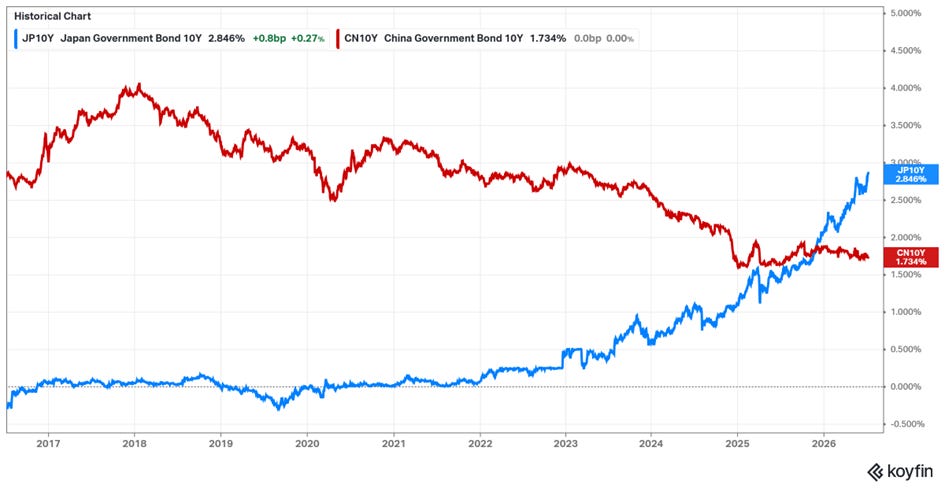
Returning to the point we made about the “cost of capital” in our previous post entitled “Croesus”, we mentioned that there has been a rising issuance in Dim Sum bonds as well as the so- called “Panda” bonds by many large corporations given the lower borrowing costs of the Chinese government, still significantly lower than in the United States and now lower than in Japan:
- Graph source Macronomics – KOYFIN
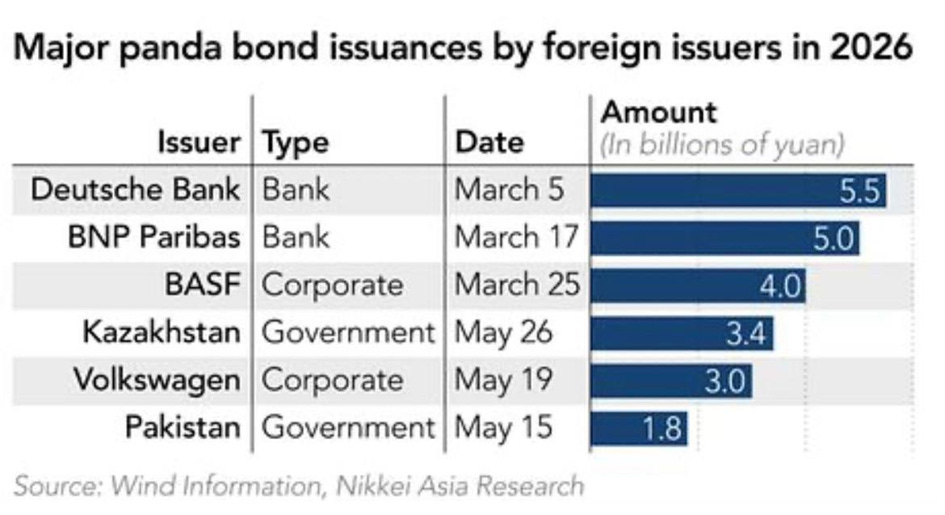
The cost advantage makes CNY funding attractive for issuers who can access it (via swaps or direct use for CNY needs), especially large corporations with operations in China or seeking to hedge/expand in renminbi:
- Graph source Wind Information – Nikkei Asia Research
Panda bonds, which are yuan-denominated bonds sold in mainland China by foreign issuers, saw a series of notable issuances in the first half of 2026, including Deutsche Bank at 5.5 billion yuan, BNP Paribas at 5 billion, BASF at 4 billion, Kazakhstan at 3.4 billion, Volkswagen at 3 billion, and Pakistan at 1.8 billion.
Ryan Lemand, PhD, made an astute comment on this trend in our Linkedin feed:
“It belongs in the same picture as central bank gold accumulation and the growth of non-Western settlement channels, since all of them are pieces of the same slow, structural diversification away from dependence on any single currency.” – Ryan Lemand, PhD
Many macro pundits focuses on the wrong target, namely the replacement of the US dollar as a reserve currency. This is what we wrote in November 2023 in our post “Brigadoon”:
“We think that a multipolar world will not lead to a new reserve currency but most likely to a system that prevailed pre 1922 (Genoa conference). The advent of floating currencies following August 1971 Fed gold decision led to the emergence of powerful central banks which corresponded to more globalization as well as more centralization. One could argue that the Great Financial crisis of 2008 marked the top of “financialization”.
Prior to 1873, the financial system was decentralized with Bills of Exchange being used and the system was a lot more resilient and stable. The first attempt at centralization was the gold standard demonetizing silver which had a catastrophic outcome and led to the great depression of 1873.
What most people do not understand is there is more “stability” in “chaos”.“- Macronomics, November 2023
As such what matters more is the infrastructure or the “pipelines” or “financial” plumbing rather than the “currency”. As such China is building its own as pointed out in a recent conversation with Marty Secada from Ivyfon/Resilient Alpha. We discussed that what matters is not a new reserve currency to replace the US Dollar but the “infrastructure” or payment systems (financial plumbing).
This was all well explained recently by Nigel Green on Asia Times on the 29th of June in his article entitled “Wall Street’s got China’s currency ambitions all wrong”.
For those of you interested on our take to the United Kingdom strong exposure to Inflation-linked bonds, here is the link to an article we just published on LinkedIn relating to United Kingdom “convexity risk”.
For those of you interested in “ongoing” Blowbacks and “sovereign credit exposure”, here is the link to an article we just published on LinkedIn relating to Bahrain’s fiscal situation being in the “crosshair”.
In a Pareto efficient economic allocation, “no one can be made better off without at least one individual worse off”.
The rest of our long monthly musings below with some tactical recommendations (we do also make some good calls) and more in-depth analysis are now for paid subscribers only.
In the rest of our conversation, we would like to look at the implications about corporate pensions funding, CAPEX and current inflationary boom as well as current trends as we have reached the mid-year mark and some additional recommendations.
Macronomics has become an affiliate partner with KOYFIN. We have used their platform extensively in last couple of years. As such, should you want to subscribe to their great platform, please find enclosed our partnership code: https://www.koyfin.com/affiliate/koyfin-with-friends/?via=martin
On a side note, we collaborate with friend Geoffrey Fouvry from GraphFinancials as you probably know from reading our Substack Macronomics. As such should you want to subscribe to Geoffrey’s top investing analysis (Geoffrey manages his own portfolio and his performance long/short, no options was around > 150% in 2025) enclosed is a discount link to subscribe to GraphFinancials services of trade recommendations. Geoffrey, like us is old school value but opportunistic as well:
https://buy.stripe.com/4gM6oI2oP7hCfkEbdZ4ZG0m
Also : You can view our YouTube conversation with Zoltan Zselyes “The Sicilian Expedition” on our YouTube channel:
Don’t hesitate to subscribe and share our work if you like our musings or go for a trial.
As well, don’t hesitate to reach out to us if you have any questions or suggestions/collaborations/consulting or want to discuss a specific topic.
