

Panda Diplomacy
“A gem cannot be polished without friction, nor a man perfected without trials” - Lucius Annaeus Seneca

Watching with interest, the wild gyrations in the Japanese yen following the Bank of Japan intervention in conjunction with the US Fed as well as the most recent Hedge Fund blow up of Situational Awareness, a leveraged “Dumb beta” sold as pure “Alpha”, when it came to selecting our title analogy, we decided instead to rather look at a Chinese reference because of the evolution of the internationalization of the Chinese currency on top of the moving parts in a sort of new financial “plumbing” being rolled out. Panda Diplomacy is the practice of sending giant pandas from mainland China overseas as a tool of diplomacy and wildlife conservation. From 1941 to 1984, the Republic of China and then the People’s Republic of China (PRC) gifted pandas to other countries. Since 1984, the giant pandas have been leased rather than gifted due to a policy change. The last giant pandas remaining in the United States in Atlanta, were returned to China in late 2024, but later the San Diego Zoo received two new pandas. Many scholars have questioned whether a deterioration in U.S.–China relations starting in the late 2010s can be seen through “panda diplomacy” between the two countries.
At the end of 2025, after a diplomatic crisis between China and Japan over Japan’s Prime Minister’s words about Chinese militarism and support of Taiwan, it was announced that two twin pandas from the Tokyo Ueno Zoo, Xiao Xiao and Lei Lei, would return to China at the end of January 2026. From a practical perspective, keeping pandas is very expensive. Besides the “rent” payable to China, obtaining enough bamboo is very expensive as well. The annual fee paid to China is approximately $1 million per pair of pandas. The agreement is usually for 10 years, up to 15 years in some cases. China retains full ownership of the adult pandas and any cubs born during the agreement.
Today, panda loans continue as a blend of soft power, conservation funding (generating significant revenue for Chinese programs), and bilateral signaling.
Why did we use such an analogy you might rightly ask?
It is a continuation of the point we made about the “cost of capital” in our previous post entitled “Croesus”, we mentioned that there has been a rising issuance in Dim Sum bonds as well as the so- called “Panda” bonds by many large corporations given the lower borrowing costs of the Chinese government, still significantly lower than in the United States and now lower than in Japan:
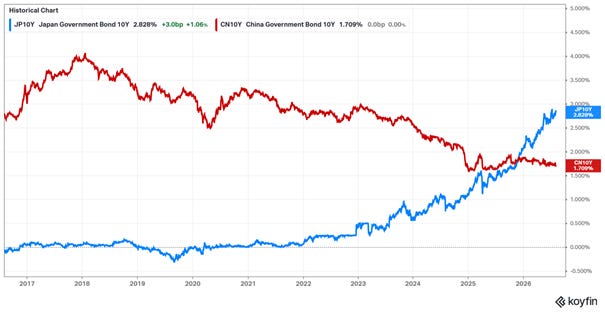
- Graph source Macronomics - KOYFIN
Panda bonds are yuan-denominated bonds sold in mainland China by foreign issuers.
China has announced it will further improve policy arrangements for “panda bonds” to facilitate more issuance and trading by overseas institutions, including sovereign states, according to the People’s Bank of China, the country’s central bank.
On top of that, the China Central Depository & Clearing Company (CCDC), announced fee reductions for multiple core services and a full waiver of issuance registration fees for international (Panda) bonds. The interest/payment settlement fee for outstanding interbank market bonds is discounted to 95% of the current rate, resulting in 0.475 bps of face value. Interest/payment settlement fees for Sci-Tech innovation bonds and Panda bonds are fully waived. Spot bond settlement fees for bond types and issuers not covered by existing concessions will be cut 10% to 135 yuan/transaction. Settlement fees for pledged repos, buyout repos and bond lending in the interbank market are reduced to 95%: pledged repo single-security 114 yuan/tx, pledged repo multi-security 190 yuan/tx; buyout repo 190 yuan/tx; bond lending (including cross-custodian and centralized lending) 190 yuan/tx. OTC bond transaction settlement fees are cut to 95%, set at 0.19 bps of face value with a per-transaction cap of 120 yuan. All measures take effect from Sept. 1, 2026 through Dec. 31, 2028.
Another illustration of “Panda Diplomacy” was the announcement in June of Brazil’s first panda bond. China’s bond market offers comparatively low yields, making yuan‑denominated borrowing financially attractive and Brazil currently has very limited foreign‑currency debt outside USD; panda bonds expand its options.
Indonesia has issued its first sovereign panda bonds in China’s interbank bond market, raising RMB7 billion (USD1.04 billion) in the largest single such issuance to date.
In H1 of 2026, issuance volume has exceeded RMB 160 bln ($23.57 billion), marking an annual growth rate of over 60%. By announcing the elimination of costs associated with the registration, interest payments, and redemption of “panda bonds”—RMB-denominated debt securities issued by foreign issuers, the Chinese government is expected to further boost the internationalization of the yuan.
So, while everyone is busy focusing on Iran oil related market gyrations, speculating on the end of the AI bubble or not, as well as on the potential end of the Japanese yen carry trade, we prefer to focus our attention to long term macro trends, namely the “panda bonds diplomacy” unfolding in real time:
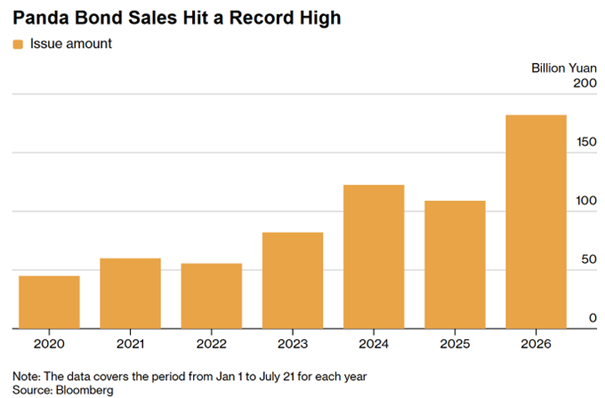
- Graph source Bloomberg – X/Twitter
To reiterate a point we made in our previous conversation, what matters more is the infrastructure or the “pipelines” or “financial” plumbing rather than the “currency”.
As such China is building its own as recent conversation with Marty Secada from Ivyfon/Resilient Alpha during the June Global Macro IvyFON panel. We discussed that what matters is not a new reserve currency to replace the US Dollar but the “infrastructure” or payment systems (financial plumbing). The IvyFON Family Office Trends & Institutional Investor Forum returns to New York City on September 15th–16th, 2026 — two days, in person, near Grand Central.30+ speakers across private credit, PE, macro, real estate, AI, healthcare, and sports IP. We will be again a guest speaker there.
Register — Online via Zoom: https://ivyfon.com/sep15-16forum/registrationonline.html
For those of you interested on our take to the United Kingdom strong exposure to Inflation-linked bonds, here is the link to an article we just published on LinkedIn relating to United Kingdom “convexity risk”.
For those of you interested in “ongoing” Blowbacks and “sovereign credit exposure”, here is the link to an article we just published on LinkedIn relating to Bahrain’s fiscal situation being in the “crosshair”.
In a Pareto efficient economic allocation, “no one can be made better off without at least one individual worse off”.
The rest of our long monthly musings below with some tactical recommendations (we do also make some good calls) and more in-depth analysis are now for paid subscribers only.
In the rest of our conversation, we would like to look at the potential bounce for gold and miners and additional take on current market set up following the pressure on US yields after Fed Kevin Warsh second meeting. We made the point in June during the previous IvyFON global macro panel that the Fed ending forward guidance would generate more volatility and therefore lower valuations. On the “volatility” point and “higher” yields, Kevin Warsh, it seems delivered.
Macronomics has become an affiliate partner with KOYFIN. We have used their platform extensively in last couple of years. As such, should you want to subscribe to their great platform, please find enclosed our partnership code: https://www.koyfin.com/affiliate/koyfin-with-friends/?via=martin
On a side note, we collaborate with friend Geoffrey Fouvry from GraphFinancials as you probably know from reading our Substack Macronomics. As such should you want to subscribe to Geoffrey’s top investing analysis (Geoffrey manages his own portfolio and his performance long/short, no options was around > 150% in 2025) enclosed is a discount link to subscribe to GraphFinancials services of trade recommendations. Geoffrey, like us is old school value but opportunistic as well:
https://buy.stripe.com/4gM6oI2oP7hCfkEbdZ4ZG0m
Also : You can view our most recent YouTube conversation with Zoltan Zselyes and our estimated guest Louis-Vincent Gave, CEO of GAVEKAL on our YouTube channel:
Don’t hesitate to subscribe and share our work if you like our musings or go for a trial.
As well, don’t hesitate to reach out to us if you have any questions or suggestions/collaborations/consulting or want to discuss a specific topic.
