

Kaì sú, téknon
“If you must break the law, do it to seize power: in all other cases observe it.” - Julius Caesar

Looking at the ongoing crisis in France with French president Macron falling to 11% of positive opinions on top of his former allies and prime ministers turning on him, in true “back-stabbing” fashion, when it came to selecting our title analogy, we reminded ourselves of the last words of Julius Caesar, “Kai su, teknon” meaning “Even you, son!”. In his famous play, Shakespeare put in Latin because more of his audience knew Latin than Greek. Julius Caesar was assassinated on the ides of March, 44 BC during a Senate session. The conspirators numbered 60 to 70 individuals and were led by Marcus Junius Brutus, Gaius Cassius Longinus and Decimus Junius Brutus Albinus. Julius Caesar was stabbed 23 times. They justified the murder of Julius Caesar as a preemptive defense of the Roman Republic. The assassination failed to achieve its immediate objective of restoring the Republic’s institutions. These events led to the rise of the Roman Empire under Augustus, marking the beginning of the “Principate” era, a form of imperial government. The assassination precipitated the end of the Roman Republic. Of course, the last words of the Roman dictator Julius Caesar are disputed. The subject of Julius Caesar’s last words is believed to have been directed at Marcus Junius Brutus, who was the son of Caesar’s favorite mistress Servilia, and was said to have been very dear to Caesar but there has been speculation that the words may have actually been meant to be said to Decimus Junius Brutus Albinus, with whom Caesar also had a very close relationship and on several occasions described as “like a son to him”. Anyway, Julius Caesar’s last words have become synonymous with betrayal in modern times due to Shakespeare play’s popularity and influence. Often President Emmanuel Macron has been qualified as a “Jupiterian” president in comparison to Louis XIV, a comparison which he rejected in July 2022 saying he was more “Vulcan” than “Jupiter”. Nonetheless we are wondering if the fall from grace from the French president is more akin to Icarus falling from the sky thanks to “excessive ambition”, and we are left wondering whether current troubles could potentially mark the end of the Fifth Republic or even the Republic itself given our pre-revolutionary mindset we have espoused on numerous occasions in our musings.
As well, we are also wondering given current political trends if the United States is not entering a “Principate” era, hence the above Julius Caesar quote we have used. The Trump administration seems clearly set on this path we think, particularly when we look at the desire to build a triumphal arch in Washington DC across from the Lincoln memorial, near the Virginia side of the Arlington Memorial Bridge. This monument would be built to celebrate the 250th anniversary of American independence in 2026. The design by architect Nicolas Leo Charbonneau, a partner at Harrison Design is inspired by the Washington Square Park arch in Manhattan and the Arc de Triomphe in Paris. The new arch would have on its top a gold winged angel and two white eagles. From an historical perspective, the French Arc de Triomphe was commissioned in 1806, after the victory at Austerlitz by Emperor Napoleon at the peak of his fortunes. During the Bourbon Restoration in which the House of Bourbon returned to power after the fall of Napoleon Bonaparte in 1814 and 1815, construction was halted until 1823. It would not be completed until the reign of Louis Philippe I in 1836. The astylar design is by Jean-François Chalgrin (1739–1811), is in the Neoclassical version of ancient Roman architecture. In 1961, U.S. President John F. Kennedy and First Lady Jacqueline Kennedy paid their respects at the Tomb of the Unknown Soldier which was placed underneath the Arc de Triomphe in 1920, accompanied by President Charles de Gaulle. After the 1963 assassination of President Kennedy, Mrs. Kennedy remembered the eternal flame at the Arc de Triomphe and requested that an eternal flame be placed next to her husband’s grave at Arlington National Cemetery in Virginia.
Are we going to see the end of Republics and the return of kings or even emperors? One might wonder.
Last year for Halloween, we left a Halloween riddle for our dear readers indicating that maybe John Ronald Reuel Tolkien had “prophetic abilities” when he wrote the trilogy of “The Lord of The Rings” and we are left wondering:
1971 - The Fellowship of the Ring (US Dollar reserves and the rise of the “Petrodollar”).
2001 - The Two Towers (9/11)
2031 - The Return of the King (the return of gold in the monetary system)
Maybe this what Gandalf, the wise “monetary” central banking wizard really meant when he could have said the below slightly amended quote?
“One currency to rule them all, one currency to find them, One currency to bring them all, and in the darkness bind them; In the Land of Mordor where the shadows lie.” – Macronomics, November 2024
Central banks have picked up the pace in the third quarter with net purchases totaling 220 tons of gold, up 28% on the second quarter and 10% year on year according to the World Gold Council and despite record high gold price:
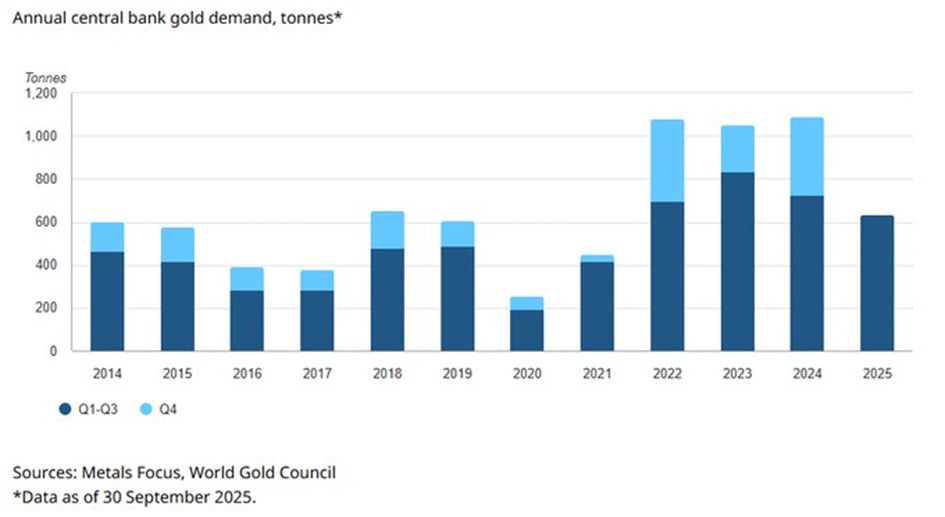
- Graph source World Gold Council
In our August conversation “Gresham’s Law” we indicated the following:
« The U.S. Treasury announced a plan to halt penny production starting the following year. The U.S. Treasury will stop minting pennies in early 2026 due to production costs exceeding face value. However, the coin will remain legal tender and in circulation, as only Congress has the power to eliminate forms of currency. » - Macronomics, August 2025.
There is as well another parallel to the Roman Empire and Julius Caesar in reference to the discontinuation of the US pennies, the Roman Denarius coin. The “denarius” was a silver coin first struck about 211 BC during the fiscal crisis Rome suffered as a result of the Second Punic War (218-201 BC). Under the Roman Empire the weight began a slow downward drift until by the time of Nero’s coinage reform the denarius was struck at about 3.6 grams. Nero re-established the standard at 3 scruples, or a theoretical 3.41 grams (96 to the Roman pound), but also dropped the fineness to about 82%. This had the unfortunate effect of invoking Gresham ‘s Law (if depreciated or debased coinage circulates concurrently with coinage of higher intrinsic value, the higher intrinsic value coins will disappear due to hoarding) and many of the early Imperial denarii were undoubtedly melted down.
At the death of Julius Caesar, who set the denarius at 3.9g, Legionary (professional soldier) pay was doubled to 225 denarii per year.
In our August conversation “Gresham’s Law” we pointed out the following comment from Alpine Macro Ceo Ritesh Jain:
“There is a great game of power being played.
On one hand president Trump talks about “Bitcoin is the new oil” and on other hand China today has officially banned cryptocurrencies …
US desperately needs Bitcoin and by extension stable coins to succeed because that’s the only way to manage US deficit. As per US treasury secretary, the U.S. treasury bonds demand from stable coins alone will reach $2 trillion by 2030.
On the other hand BRICS currency is GOLD as countries in BRICS are warming up to net settling their trade balances in Gold.
US needs stable coins and bitcoin to succeed… China on the other hand has officially gone on record to ban cryptocurrencies….
The irony is not lost on me…. As China has excess and ample cheap power to mine Bitcoin whereas U.S. will start having blackouts by 2027 due to shortage in power supply.” - Ritesh Jain - Pinetree Macro
The significant rise of both gold and silver year to date, points we think towards a “Romanification” of the United States, from Republic, to “Empire”.
We also added the following in our August conversation:
« In addition to being melted down for its bullion value, money that is considered to be “good” tends to leave an economy through “international trade” (gold is flying East…). International traders are not bound by legal tender laws as citizens of the issuing country are, so they will offer higher value for “good coins” than “bad ones”. The “good coins” may leave their country of origin to become part of international trade, escaping that country’s legal tender laws and leaving the “bad” money behind. It happened before. This occurred in Great Britain during the period of adoption of the gold standard: In 1717 Isaac Newton, then Master of the Mint, declared the gold guinea to be worth 21 silver shillings. This overvalued the gold guinea in Great Britain, making it “bad”, and encouraged people to send “good” silver shillings abroad, where it could buy more gold than at home. This gold was then minted as currency, which bought silver shillings, which were sent abroad for gold, and so on. For a century hardly any silver coins were minted in Great Britain, and Britain moved onto a de facto gold standard. » - Macronomics, August 2025.
We concluded at the time that the primary mandate of the US Fed has switched from “price stability” to “asset prices” stability. Given we contend that the more financialized an economy is, the more “unstable” it becomes. The current Repo « funk » we are seeing with the Repo spikes is leading us to think that the Fed will have no choice but to restart QE in very short order.
Not only the currency value of the US dollar is being eroded, but it is done in conjunction with central bank independence and « democracy », hence our previous « Erdoganification » analogy when it comes to « Fiscal Dominance » à la Turkiye.
In this conversation we would like to look at rising cracks in the US Repo markets and what it entails. As well the calm in public markets with very tight spreads is justified by the abundant amount of “liquidity” sloshing some might opine meanwhile the US Repo markets have a different take on “liquidity”. To paraphrase Frederic Bastiat, when it comes to “credit”, there is what is seen and what is not seen, and we think private credit is indeed hiding a lot to desire for, one being “liquidity”. We will also look at an additional play during “money illusion” and “Erdoganification” period, following the recent gold and silver “smack down”.
On a side note, 162.46% YTD performance (MTD 11.96% for October):

- Graph source Geoffrey Frouvry - GraphFinancials
This is the performance of our friend Geoffrey Fouvry from GraphFinancials. As you probably know from reading our Substack Macronomics we collaborate with Geoffrey. As such should you want to subscribe to Geoffrey’s investing analysis (Geoffrey manages his own portfolio) enclosed is a discount link to subscribe to GraphFinancials services of trade recommendations:
https://buy.stripe.com/4gM6oI2oP7hCfkEbdZ4ZG0m
Happy Halloween!
The rest of our long monthly musings below with some tactical recommendations (we do also make some good calls) and more in-depth analysis are now for paid subscribers only.
Don’t hesitate to subscribe and share our work if you like our musings or go for a trial.
As well, don’t hesitate to reach out to us if you have any questions or suggestions or want to discuss a specific topic.
