

Civilized Money
“In a revolution, as in a novel, the most difficult part to invent is the end.” - Alexis de Tocqueville

Looking at the parabolic rise in both gold and silver and the most recent very significant retracement in conjunction with the rising tensions in Minneapolis in the United States, as we are heading towards the probable nomination of Kevin Marsh as a replacement of departing Fed Chairman Jerome Powell, when it came to selecting our title analogy being our trademark style of writing, we decided to go for “Civilized Money”. “Civilized Money: The Way to Prosperity, Happiness, Civilization” was written by Charles M. Howell in 1895. Charles M. Howell was a less-documented figure compared to more modern economists, but his work is notable for its advocacy of a monetary system rooted in trust, morality and cooperation. In his 1895 work, Charles M. Howell argued that money can be a civilizing force, promoting human flourishing and cooperation rather than greed or exploitation. His vision was all about a monetary economy that emphasized ethical principles and social harmony as the foundation for prosperity and civilization. Charles M. Howell’s work is sometimes associated with proposals for decimal-based monetary systems and universal standards, inspired in part by the metric system’s success in France. Charles M. Howell was an advocate for monetary reform during the late 19th century, a period marked by significant economic upheaval, including debates over the gold standard, bimetallism, and the role of banks in society.
The key themes in the “Civilized Money” book are as follows:
Money as a Civilizing Force: Howell argues that money, when structured correctly, can foster cooperation, trust, and social harmony rather than greed or exploitation. He sees it as a tool for human flourishing and the advancement of civilization.
Moral and Ethical Foundations: The book emphasizes that a monetary system should be built on moral principles—trust, fairness, and mutual benefit—rather than speculation or manipulation. Howell critiques the existing financial systems of his time for fostering inequality and instability.
Universal Standards: Inspired by the metric system, Howell proposes a universal, decimal-based monetary system that could be adopted globally. He believed this would simplify transactions, reduce fraud, and promote economic unity among nations.
Practical Proposals: The book includes specific proposals for reforming currency, weights, and measures, aiming to create a more rational and equitable economic framework.
The late 19th century was a time of rapid industrialization and globalization, but also of economic crises and social unrest. Howell’s ideas reflect a broader movement seeking to address these challenges through systemic reform.
If we do a comparison with the current period which is marked by the rise of AI and its impact on Monetary Systems, one could argue that artificial intelligence is reshaping global economies, driving unprecedented demand for computing power, and influencing financial markets. AI is seen as both a catalyst for growth and a source of risk, with regulators warning of potential market bubbles and the need for careful oversight.
As well some financial pundits argue that Bitcoin could be seen as “Digital Gold”. Some financial analysts view Bitcoin as a hedge against inflation and currency devaluation, much like gold. Its fixed supply (capped at 21 million coins) and decentralized nature have been appealing to those seeking alternatives to traditional fiat currencies. Both Bitcoin and gold are influenced by global liquidity cycles and geopolitical uncertainty.
Howell’s proposal for a universal, decimal-based currency shares some similarities with Bitcoin’s global, borderless nature. However, Bitcoin’s volatility and speculative nature differ from Howell’s vision of a stable, trust-based system. Howell wrote during the gold standard era, when gold was the backbone of monetary systems. The current rush to gold echoes Howell’s belief in the importance of tangible, trustworthy assets—but in a world where digital and physical assets coexist.
In a recent conversation with our Quant friend, he made us notice the low Sharpe ratio of Bitcoin since inception of 0.84:
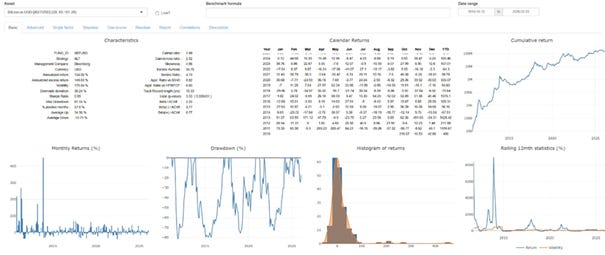
- Table source – Quant friend
In-sample the Beta / MSCI World (ACWI) is 2.25 and beta at 3.77. We therefore agree with our quant friend and consider Bitcoin as a big GAFA (Google, Apple, Facebook, and Amazon) play.
As an illustration, the beta of Bitcoin relative to the NASDAQ is around 2 over the period and even recently:
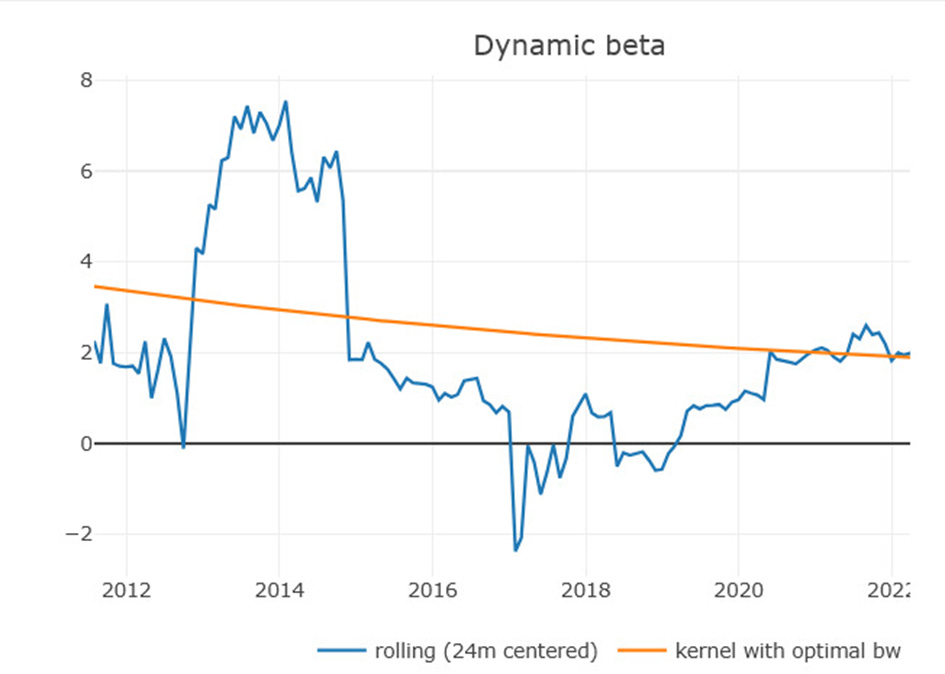
- Graph source – Quant friend
Sure, correlation is low (0.18) but given the volatility ratio, we get a beta of 1.82 since 2020 versus NASDAQ:
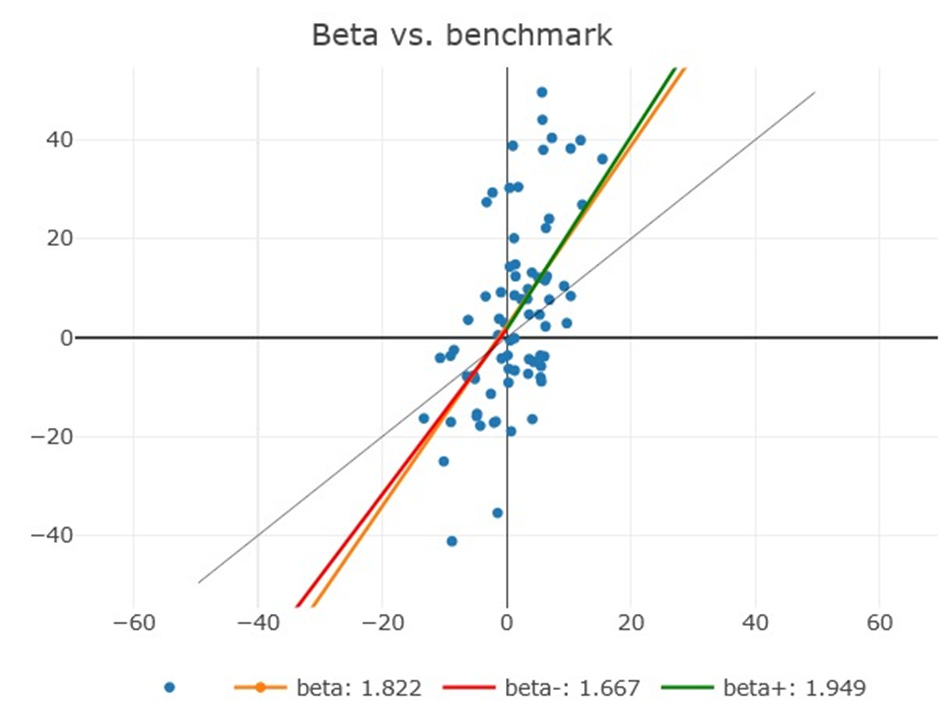
- Table source – Quant friend
Nonetheless over the period Bitcoin has been a strong “alpha” generator relative to Nasdaq leveraged at 1.82. Correlation for the last 5 years (since 2020) is at 0.56 so not really “Digital Gold” but more GAFA like.
Correlation between of Bitcoin relative to Gold since 2020 is at 0.05:
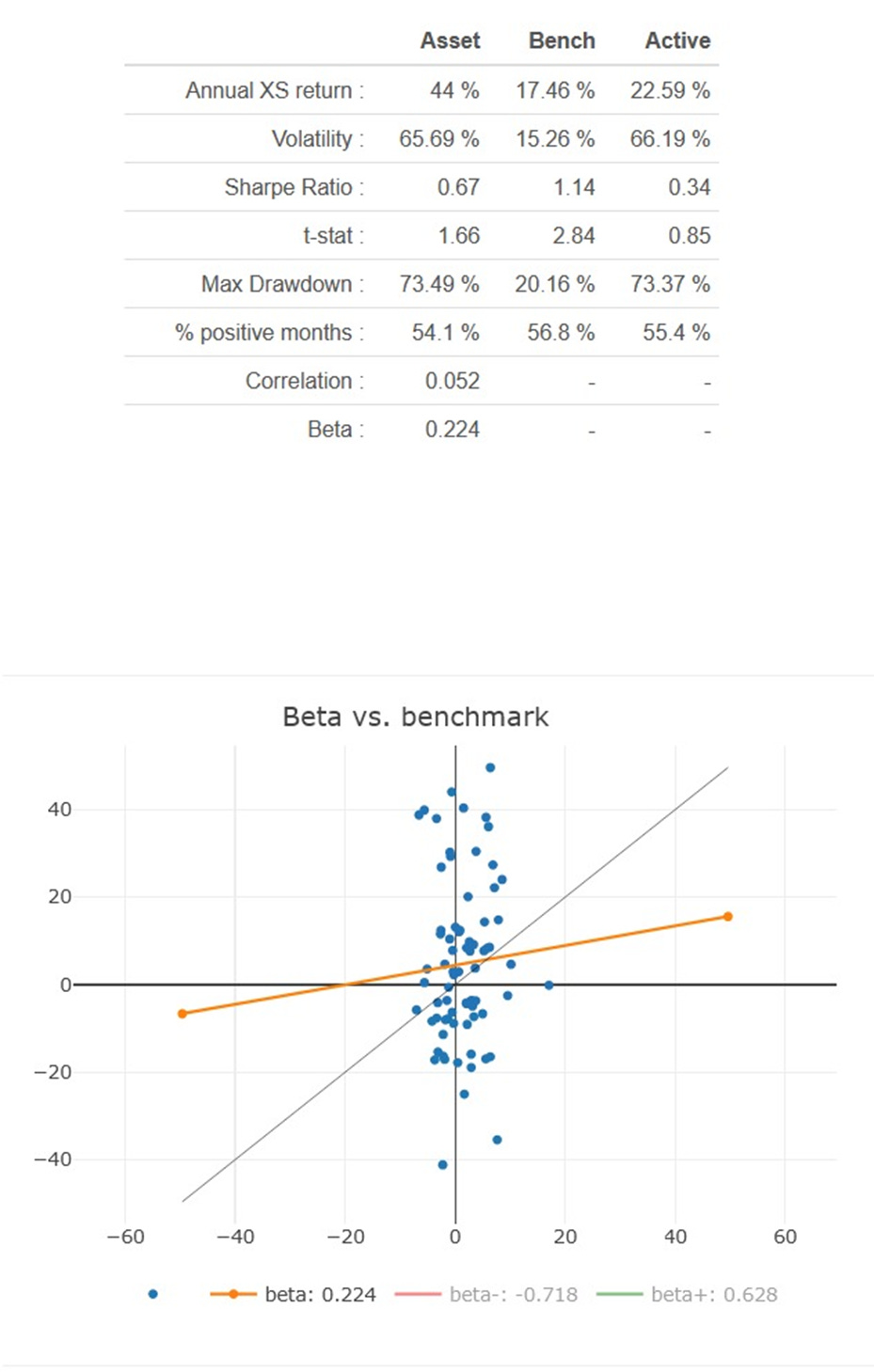
- Graph source – Quant friend
On the recent “bifurcation” between Digital Gold (Bitcoin) and Gold, we read with interest Charles Morris take on our X/Twitter feed:
“A year ago, one bitcoin bought 40 ounces of gold. Today that has fallen to 18. One feature of this relationship is linked to bonds. By combining 10-year Treasury yields and 10 yr inflation expectations, there has often been a good fit, but that has recently broken as gold is on a tear, and Bitcoin has been weak.”
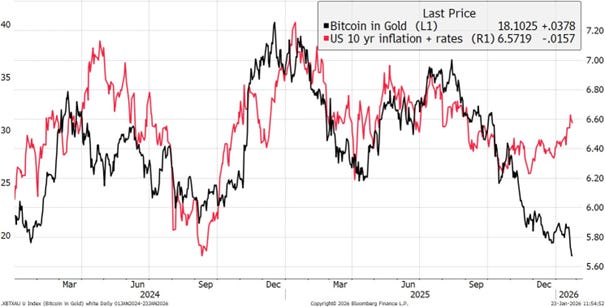
- Graph source – Charles Morris – X/Twitter
Charles Morris argues that if bond yields and inflation expectations keep rising, the macro environment should shift from gold to bitcoin.
He also adds that Bitcoin and Gold work together as highlighted in the below chart displaying Bitcoin vs Gold vs ETP BOLD vs MSCI World as of the 17th of December 2017:
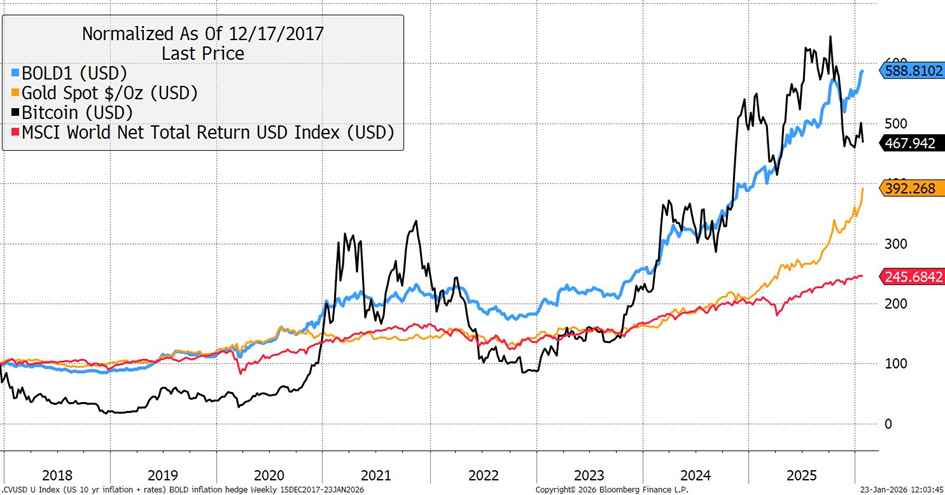
- Graph source – Charles Morris – X/Twitter
Another interesting point made by Charles Morris when it comes about “Civilized Money” is as follows:
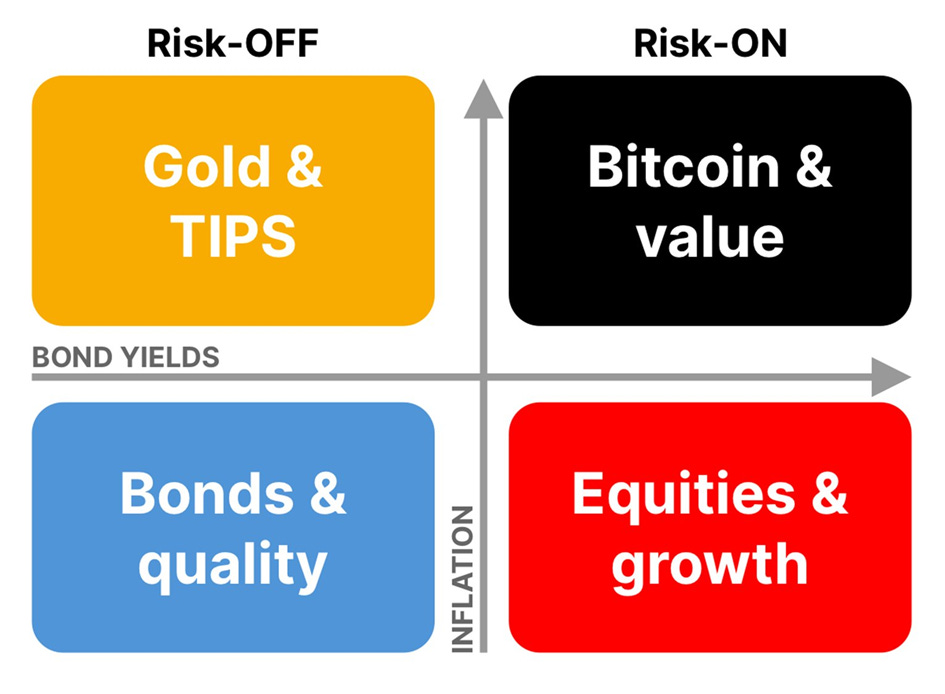
“My thesis has always place gold in the top right, and bitcoin in the top left. » - Charles Morris
Where we differ is that we think that long term drivers are more related to growth relative to inflation rather than bond yields relative to inflation. Gold never fails to respond to Gibson’s paradox, as such reacts to a change in “real rates”. Bitcoin, it seems to us, respond more to “growth” as a levered beta play such like GAFA as we posited above.
In this conversation we would like to look at the most recent sell-off in silver (a Dragon King rather than a Black Swan in true Didier Sornette/LPPL fashion) and precious metals and the continuation of international diversification and the attractiveness of Brazil markets.
On a side note, we collaborate with friend Geoffrey Fouvry from GraphFinancials as you probably know from reading our Substack Macronomics. As such should you want to subscribe to Geoffrey’s top investing analysis (Geoffrey manages his own portfolio and his performance long/short, no options was around > 150% in 2025) enclosed is a discount link to subscribe to GraphFinancials services of trade recommendations. Geoffrey, like us is old school value but opportunistic as well:
https://buy.stripe.com/4gM6oI2oP7hCfkEbdZ4ZG0m
The rest of our long monthly musings below with some tactical recommendations (we do also make some good calls) and more in-depth analysis are now for paid subscribers only.
Don’t hesitate to subscribe and share our work if you like our musings or go for a trial.
As well, don’t hesitate to reach out to us if you have any questions or suggestions or want to discuss a specific topic.
